Our experience spans two dedicated websites.
Discover the world of Collaborative and Meeting Spaces:
Discover the world of Collaborative and Meeting Spaces:

A server goes silent. A fiber link drops. A business-critical app starts dragging. In most organizations, problems like these are spotted, triaged and fixed by a NOC, or Network Operations Center. This team keeps round-the-clock watch over IT and telecom infrastructure, and often catches issues before users have any idea something’s wrong. But the term covers a lot of ground. One company’s NOC might be three people sharing an office. Another’s might be a 24/7 control room packed with video walls and multi-monitor workstations. Knowing what a NOC actually is, how it differs from a SOC and what makes one work well goes a long way toward getting a project off on the right foot.
Key takeaways
A NOC is a physical or virtual hub where a team of engineers and technicians keeps tabs on the health of an organization’s networks and systems. You’ll also hear it called a network monitoring center, an operations center or a network management center. Its remit typically includes network gear (routers, switches, firewalls, WAN links), servers, storage and mission-critical applications. At service providers, it extends to telecom and satellite networks as well.
NOCs first appeared at telecom carriers. These days, they’re just as common at hosting companies, data centers, managed service providers and large enterprises. Public sector bodies and critical infrastructure operators in fields like energy and transportation run them too.
Pretty much any organization that can’t afford for its network to go down. A telecom operator might be watching thousands of devices spread across an entire region. A hospital has to keep patient records and connected medical equipment accessible at all times. A manufacturer needs the networks linking its plants to stay up. And a managed services provider runs a NOC on its clients’ behalf, backed by contractual service level agreements.
Requirements vary a lot depending on the size of the estate and how much downtime is acceptable. Some organizations get by with business-hours monitoring. Others need staff on the floor 24/7, with response times measured in minutes.
Monitoring is the heart of the operation. Tools continuously gather metrics (availability, latency, bandwidth, CPU load, disk space) and event logs. When a threshold is breached, an alert goes out to operators. The aim is to catch a problem while it’s still brewing, before it turns into an outage people can see.
An alert doesn’t always mean an incident. The Tier 1 operator checks it out, correlates related events and works out the real impact. If the issue is beyond their remit, they escalate it to Tier 2 or 3, a subject matter expert or a vendor. This tiered approach, usually modeled on ITIL practices, keeps senior engineers from being pulled into simple fixes.
A NOC isn’t purely reactive. It schedules maintenance windows, rolls out patches, keeps an eye on network capacity and produces uptime reports. The metrics that get the most attention are MTTD (mean time to detect), MTTA (mean time to acknowledge) and MTTR (mean time to resolve). Tracked over time, they show how well the center is really performing.
When a major incident hits, the NOC becomes mission control. It keeps business teams, customers and leadership in the loop, and logs every action taken. Clear, timely updates mean fewer inbound calls, which frees technicians to focus on the fix.
The cost of downtime goes a long way toward explaining why. According to the Uptime Institute, 57% of respondents to its 2025 annual survey said their most recent major outage cost them more than $100,000. For the second year in a row, one in five organizations put the figure above $1 million. (source: Uptime Institute, Annual Outage Analysis 2026, May 2026).
For the world’s biggest companies, the numbers are staggering. Splunk and Oxford Economics surveyed 2,000 executives at Global 2000 firms. Their research puts the cost of unplanned downtime at $400 billion a year, which works out to around $200 million per company and close to 9% of profits. Each minute of downtime costs an average of $9,000. (source: Splunk and Oxford Economics, The Hidden Costs of Downtime, June 2024).
The Uptime Institute report holds another takeaway that hits close to home for NOC teams. Failure to follow established procedures is still the top cause of outages tied to human error. Fiber and connectivity incidents are also on the rise, and the outages they cause are lasting longer. Put simply, solid processes and good working conditions for operators matter every bit as much as the technology.
Monitoring centers have similar-sounding names, and the boundaries between them can blur. Here’s how their roles break down.
| Center | Main goal | What it monitors | Key metrics |
|---|---|---|---|
| NOC (Network Operations Center) | Uptime and performance | Networks, servers, applications, telecom links | Availability, MTTR, SLA compliance |
| SOC (Security Operations Center) | Threat detection and response | Security events, suspicious activity | Time to detect, time to contain |
| Hypervision center | Single pane of glass and overall control | Aggregated business and technical monitoring tools | Business impact, incident correlation |
| Help desk / service desk | End-user support | User-reported requests and incidents | Response time, user satisfaction |
The NOC asks, “Is the service up?” The SOC asks, “Are we under attack?” A sudden bandwidth spike might just be a legitimate surge in traffic, which makes it a NOC issue. Or it could be a denial-of-service attack, which puts it squarely in the SOC’s court. That’s why the two teams need to share information in real time.
Some organizations put both centers side by side, or even combine them in a single space. That makes coordination much easier during major incidents. The trade-off is that access rights need careful management, and responsibilities have to be clearly defined. The right setup depends on team size, maturity and regulatory obligations, especially for critical infrastructure operators. Security tooling follows its own logic, which we cover in SOC: choosing the right tools.
Once an organization has layered several monitoring tools on top of each other, operators end up hopping from console to console. Hypervision pulls all those sources into a single view, correlates events and translates technical alerts into business impact. For a NOC, that means less noise and faster root cause analysis.
Network monitoring platforms gather data via SNMP, NetFlow, syslog or agents installed on servers. There’s no shortage of options, with Centreon, Zabbix, Checkmk, PRTG, SolarWinds and ManageEngine among the most widely used. Which one fits best depends on the size of the estate, the licensing model, how well it integrates with existing systems and the skills available in-house.
Observability takes things a step further. By pulling together metrics, logs and application traces, it helps teams understand how a complex system behaves, not just whether it’s up or down. In practice, the early warning signs of an outage often show up well before anything actually breaks. Network monitoring: what makes the difference in the field takes a closer look at these signals, and our article on IT asset monitoring explores the topic further.
A ticketing system tracks every incident from the moment it’s detected to the moment it’s closed. It gives structure to escalation, keeps a full history and feeds into service level reporting. Paired with a solid knowledge base, it lets Tier 1 operators resolve more issues on their own.
In a data center, the NOC also watches power, cooling and rack space. DCIM (Data Center Infrastructure Management) tools bridge the gap between IT and facilities. That’s no small detail: according to the Uptime Institute, power issues remain the leading cause of high-impact outages.
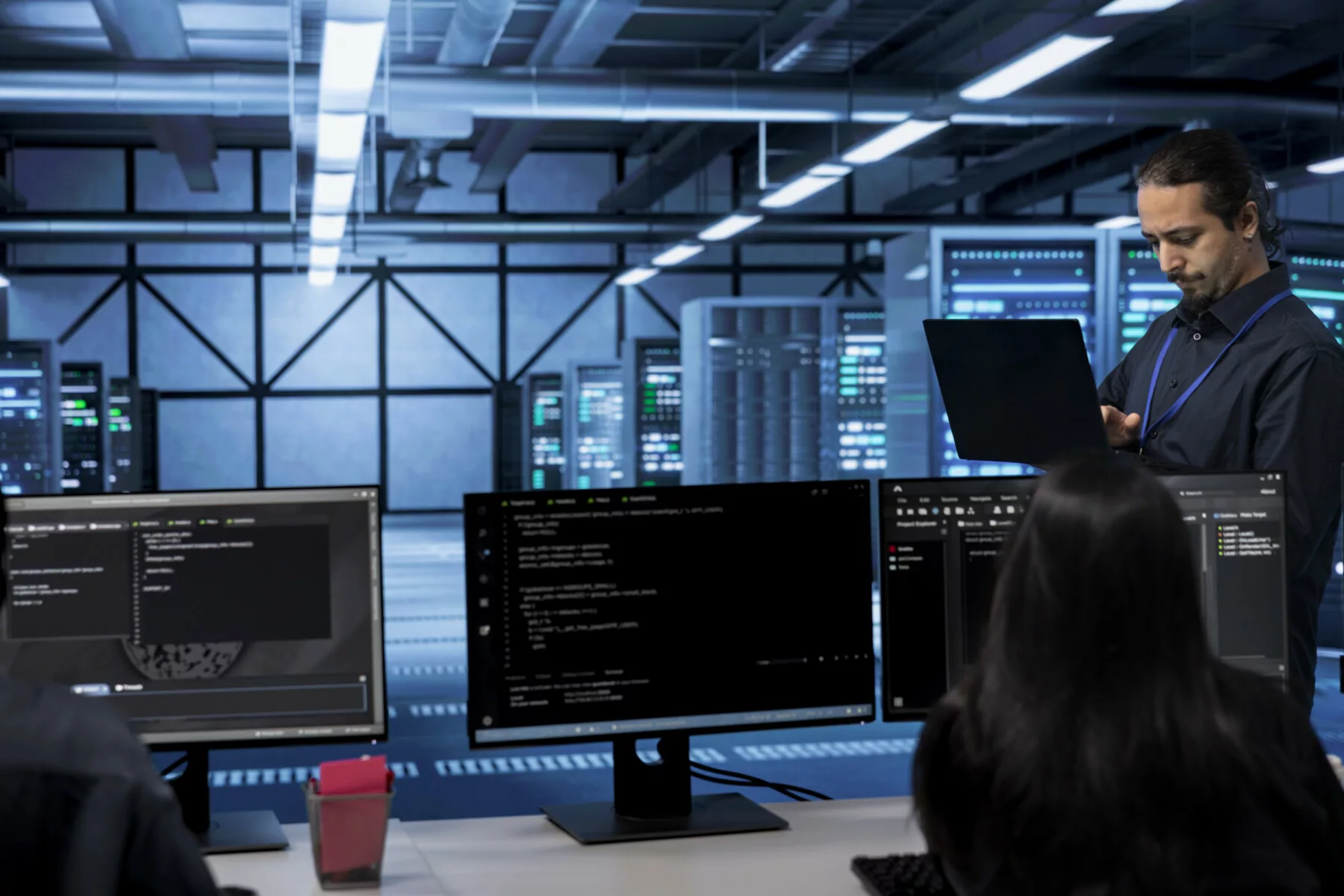
A NOC that runs 24/7 is a control room in every sense. Operators spend long shifts interpreting critical data, often under pressure. The way the room is designed has a direct effect on how alert they stay and how quickly they can respond.
Most projects revolve around three things. The video wall shows what the whole team needs to see at once: network maps, major alarms and uptime dashboards. Multi-monitor operator workstations, usually connected through a KVM system, give access to monitoring consoles without cluttering the room with hardware. And ergonomics, guided by the ISO 11064 standard, covers layout, lighting, acoustics and technical furniture built for round-the-clock use.
The piece that’s most often overlooked is alarm management. When a screen is flooded with hundreds of minor alerts, a critical one can slip right past. Good design prioritizes alerts and saves the video wall for events that call for a team response. Our guide to control room ergonomics walks through these decisions in more detail.
A regional network operator monitors several thousand devices across around a hundred sites. Its old setup was little more than standard offices and a few TVs mounted on the wall. Operators flipped between consoles, and major incidents were coordinated over the phone.
The new NOC is built around a video wall displaying the network map and critical alarms. Six multi-monitor operator workstations face the wall, with a slightly raised shift supervisor station behind them. A crisis room next door hosts the incident management team when major issues arise. The biggest win isn’t technological at all: everyone now sees the same information at the same time.
Building a NOC draws on a range of disciplines: usage analysis, ergonomics, AV, technical furniture and monitoring tool integration. Motilde supports organizations across the board, from auditing their existing monitoring setup to delivering the finished control space. Our NOC room design page offers an expert guide for organizations planning a project, covering team structure, key metrics, room layout and monitoring tools.
AIOps and automation. AIOps platforms bring artificial intelligence to event correlation. They group alerts that stem from the same root cause and recommend fixes. Some routine tasks, like restarting a service, are already automated. That said, the Uptime Institute warns that more automation can also introduce entirely new types of incidents.
NOC-SOC convergence. Some threats, ransomware being the obvious example, go straight for availability. In response, more and more organizations are bringing their network and security teams under one roof.
Growing reliance on third parties. Between public cloud, carrier links and SaaS, a growing share of incidents now start outside the organization’s own perimeter. That means the NOC has to keep an eye on its suppliers too.
Hybrid NOCs. Teams are pairing a physical room for critical operations with remote access for on-call staff. The room is still the go-to place in a crisis, when being in the same space makes all the difference.
NOC stands for Network Operations Center. It’s where a team monitors, manages and maintains an organization’s networks and IT infrastructure. A NOC can be run in-house or outsourced to a managed services provider.
A NOC keeps networks and systems available and performing well. A SOC, or Security Operations Center, detects and responds to cybersecurity threats. The two sometimes monitor the same equipment, but with different goals in mind. They work hand in hand on incidents that involve both an outage and an attack.
A typical NOC team includes Tier 1 monitoring operators or technicians, Tier 2 and 3 network and systems engineers, and a NOC manager or shift supervisor. Larger centers may also have monitoring tool specialists and vendor managers.
Not always. It depends on service commitments and how critical the infrastructure is. Telecom operators, hosting providers and critical infrastructure generally run around the clock. Other organizations staff the NOC during the day and rely on remote on-call engineers overnight, with automated monitoring raising the alerts.
A NOC room usually includes a video wall for shared situational awareness and multi-monitor operator workstations. On top of that, it needs a KVM system to manage sources, technical furniture built for continuous use and backup power. Ergonomics, lighting and acoustics complete the picture by helping operators stay sharp. Our NOC room design solutions break these choices down by center size and requirements.
Outsourcing makes sense for organizations that don’t have the skills or headcount for continuous monitoring. It delivers 24/7 coverage at a predictable cost. An in-house NOC, on the other hand, brings deep knowledge of the systems and close ties with business teams. Many organizations end up with a hybrid model.
The NOC is the nerve center of digital uptime. By keeping constant watch over networks, servers and applications, it shortens incidents and limits their impact at a time when downtime keeps getting more expensive. Its effectiveness depends on getting the balance right between monitoring tools, rigorous processes and the right working environment.
Over the next few years, AIOps, convergence with cybersecurity and third-party monitoring look set to reshape the role of the Network Operations Center. Operators will spend less time sifting through alerts and more time making decisions. And the room itself will remain the place where information turns into action.

Copyright © 2026. MOTILDE. All rights reserved.