
Last update: 16/02/26
Imagine a network operator monitoring more than ten separate screens, juggling three keyboards and just as many mice. Even worse, the content on the screens shifts constantly with events, with no clear connection between them. Thankfully, this nightmare belongs to the past. Modern control room technologies have completely transformed these environments into spaces where information flows efficiently, helping operators make faster and more reliable decisions.
In industries like energy, manufacturing, IT and telecom, transportation, or security, a seemingly minor incident can have serious consequences. Consider an energy infrastructure control room: a transformer overheats somewhere on the outskirts of a major city, and the operator notices the anomaly 10 minutes too late. The result is hundreds of thousands of homes without electricity for four hours, costing millions of euros and damaging the company’s reputation.
With advanced control room technologies, the same incident is detected instantly. The SCADA system identifies the abnormal temperature rise. The video wall automatically highlights the affected area. AI proposes three response scenarios, while a dedicated interface consolidates the key data needed to act. The operator corrects the issue in two minutes. Incident resolved, no homes impacted.
The difference between 10 minutes and 2 minutes explains why infrastructure managers invest in these solutions. This is not about technological luxury; it is about service continuity and operational reliability.
The video wall is often the most visible and impressive feature of a modern control room. This large-format display technology allows multiple information sources to be presented simultaneously on a unified visual surface, giving operators an immediate, shared overview of the operational situation.
Here is a problem that few anticipate. You install a brand-new video wall with perfectly uniform colors. Six months later, some panels have yellowed slightly while others shift toward blue. The weather map now displays three different shades of blue across regions. Operators experience chronic visual fatigue as they compensate mentally for these distortions.
Professional video walls include colorimetric sensors. Every night, the system automatically measures each panel, detects color drift, and corrects it in real time. Delta E remains below 2, meaning the human eye cannot perceive any difference between adjacent panels.
This feature alone separates professional installations from basic setups. An operator working eight hours in front of a perfectly calibrated display stays focused. One squinting to distinguish shades may miss subtle signals that could indicate major problems.
This question comes up frequently in control room projects.
An LED video wall with a 1.2 mm pixel pitch costs three times as much as an equivalent LCD. For some applications, the added expense is not justified. For others, it is essential.
Take a crisis room that must operate for extended periods, with windows facing south and variable natural light. A standard LCD wall becomes unreadable when the sun hits it. Blinds must be closed and strong artificial lighting turned on, creating a bunker-like environment and adding fatigue.
LED displays can change the equation. With stable brightness of 2,000 cd/m², they remain fully readable even in direct sunlight. Operators can work in natural light, maintaining a professional but comfortable environment. The comfort gain translates into higher productivity and lower absenteeism.
Conversely, in a windowless control room with controlled artificial lighting, an LCD is often perfectly adequate.
SCADA (Supervisory Control and Data Acquisition) systems form the first layer of supervision in industrial and process environments. These software platforms collect data from distributed equipment, often across large geographic areas, and allow operators to monitor and remotely control complex processes.
SCADA architecture includes several key components. At the field level, programmable logic controllers (PLCs) and remote terminal units (RTUs) collect data from sensors and actuators. These devices communicate with SCADA servers via specialized industrial protocols like Modbus, DNP3, OPC UA, or IEC 61850, depending on the sector.
SCADA servers centralize the information, perform calculations, generate alarms, and store historical data. Operator workstations display graphical synoptics representing the supervised processes, allowing operators to visualize system status and issue control commands.
This client-server architecture can be deployed locally or increasingly on cloud infrastructures for greater scalability and resilience.
The 2017 Triton attack could have ended in disaster. Hackers penetrated the SCADA systems of a Saudi petrochemical plant and disabled safety systems, aiming to cause an explosion. A bug in their code prevented catastrophe.
Since then, cybersecurity in control room technologies has become a top priority. IEC 62443 now defines minimum standards, but a gap often exists between paper compliance and real security.
The core issue is that SCADA systems are expected to last 15 to 25 years, while cyber threats evolve monthly. A system secure in 2020 could be vulnerable by 2026 if updates are not maintained.
A defense-in-depth strategy is essential. First layer: physically segmented networks. Field devices communicate over isolated networks. Second layer: industrial firewalls inspecting every SCADA protocol packet. Third layer: behavioral detection identifying abnormal actions. Fourth layer: multi-factor authentication for all human access. Systems can also employ whitelists, allowing communication only between authorized machines.
KVM (Keyboard, Video, Mouse) solutions are vital in control rooms, enabling operators to manage multiple computers from a single workstation. They significantly improve operational efficiency while optimizing space in often limited environments.
KVM matrices connect multiple IT sources (servers, workstations, video equipment) to multiple operator stations. Operators can switch instantly between sources, access remote systems, and control critical equipment without physically moving between stations.
KVM solutions come in various architectures. Simple KVM switches allow one user to access multiple local computers. KVM matrices provide many-to-many connectivity, allowing any operator to access any source. IP-based KVM eliminates distance limitations, enabling control of equipment in remote server rooms or other sites via the network.
Advanced KVMs now support 4K and higher resolutions, multi-user collaboration, video streaming to remote displays including video walls, and ultra-low latency (4–5 ms) for critical environments.
KVM systems are moving toward virtualization. Virtual desktop infrastructure (VDI) and container technologies enable full work environments to be accessed via KVM, simplifying IT management and enhancing security.
Integration with hybrid cloud environments is another major trend, supporting rapid failover to backup sites.
User interfaces are also evolving. Touchscreens enable intuitive navigation, multi-touch gestures facilitate zooming and navigating complex content, and smart search locates specific sources among dozens or hundreds of connected devices.
Virtual assistants like ChatGPT have become commonplace on smartphones. Their integration into control room technologies represents a major shift.
Imagine an operator facing a complex alarm they have never seen. Traditionally, they would consult a 300-page manual to find the relevant procedure, costing 5 to 12 minutes under stress.
With conversational AI: asking “What is the procedure for a low-pressure alarm in the north sector with abnormally high temperature?” returns an instant answer with four exact steps, SCADA system screenshots, and thresholds specific to that installation.
Better yet, asking “Show me the last three occurrences of this alarm and how they were resolved” lets the AI extract history, identify patterns, and suggest the most effective action.
This support turns junior operators into assisted experts, reducing training time from 18 months to six and cutting error rates by 60 percent. Senior operators can focus on truly complex situations requiring experience and judgment.
Control rooms are increasingly integrating digital twins, which simulate the real infrastructure with extreme fidelity.
An electric grid manager wants to test a new load-shedding configuration. On the real network, errors could black out thousands of homes. On the digital twin, all experiments are safe.
The twin replicates the network’s topology, loads, equipment, and constraints. The operator tests scenarios, observes consequences, adjusts parameters, and repeats. After several iterations, the optimal scenario emerges, which is then deployed on the real network.
Digital twins are also used for training. Operators can practice major incidents without real-world consequences: transformer failures, pipeline leaks, substation fires – all scenarios become safe exercises.
Though still expensive – ranging from several hundred thousand to millions of euros depending on infrastructure complexity – the safety and training benefits justify the investment for critical systems.
The COVID pandemic accelerated an existing trend: operating critical infrastructure remotely.
Modern control room technologies now support distributed architectures. The operational core remains on-site with maximum redundancy, but operators can connect from secondary sites or home in emergencies.
Key considerations include security, latency, and ergonomics: end-to-end encrypted connections, biometric authentication, hardened VPN tunnels, response times identical to the main site, and reproducing the visual environment of the physical room.
Some organizations deploy secondary control rooms in different locations. In case of natural disasters, cyberattacks, or any event making the primary site unusable, the secondary site can take over within minutes.
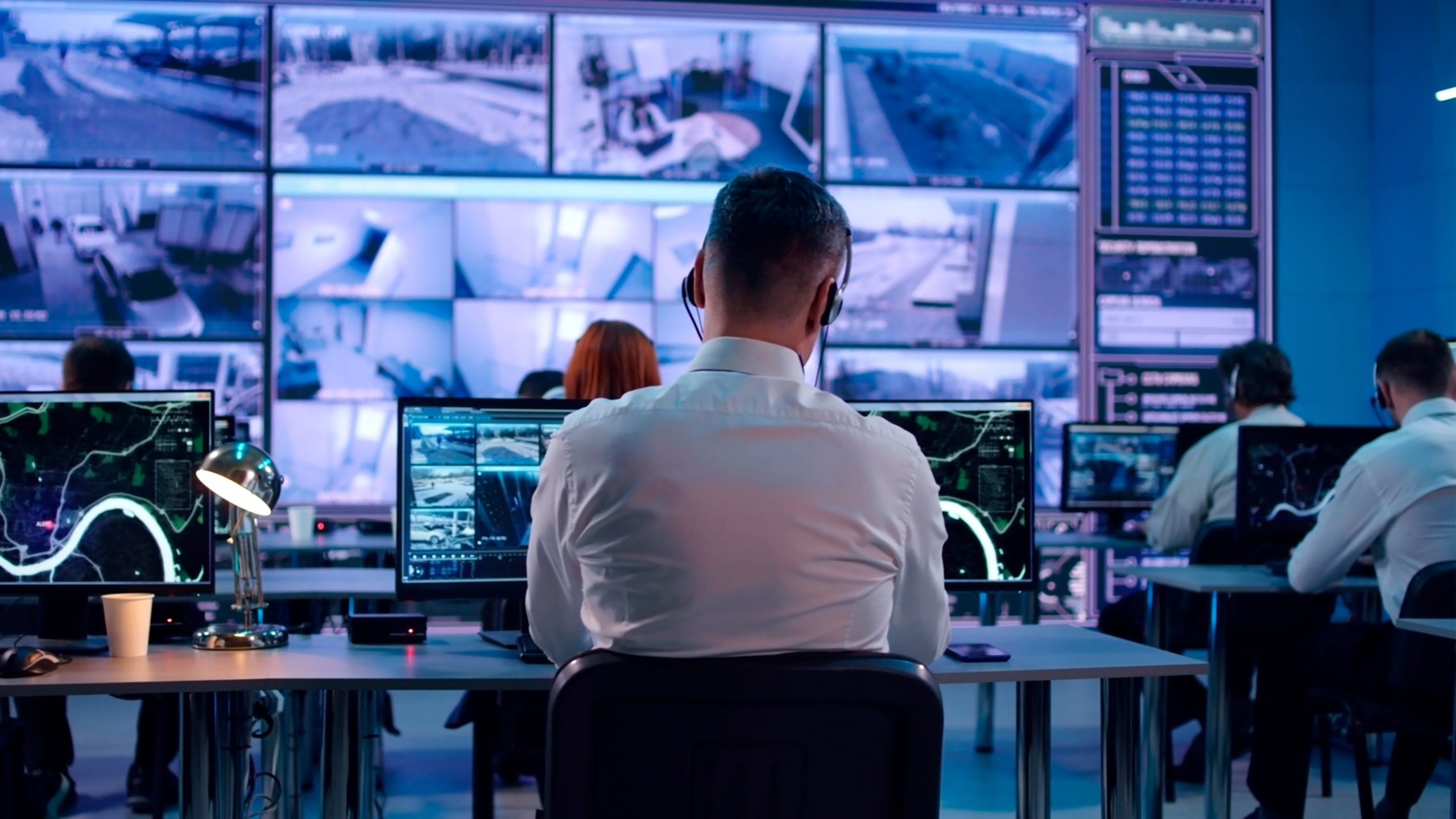
A professional video wall differs from a simple multi-screen setup in several ways. It allows pixel-precise placement of any content across the wall, creating a single continuous surface. Panels are designed for 24/7 operation with reinforced components and optimized cooling. Ultra-thin bezels provide a near-seamless visual surface. Automatic calibration ensures consistent color and brightness. Management software allows centralized control of all content.
Yes. SCADA systems are designed to run autonomously on isolated local networks, which is also a cybersecurity best practice. Internet connections are generally used only for remote maintenance, supervised remote access, or cloud analytics, with strict security measures like VPNs, strong authentication, and network segmentation.
A control room has multiple layers of longevity. Physical infrastructure (furniture, HVAC, structured cabling) can last 15–20 years with proper maintenance. Video wall panels typically last 7–10 years under continuous use. IT equipment follows a 4–6 year refresh cycle. Software is updated regularly, with major overhauls every 5–8 years. A modular approach allows gradual updates without disrupting operations.
Sizing a KVM matrix depends on several factors: the number of sources to connect, the number of operator stations, resolution and refresh rate requirements, distance constraints, future expansion margin (20–30 percent recommended), and latency requirements, which may influence the choice of more or less expensive hardware.
Standards include ISO 11064 for ergonomic design, IEC 62443 for industrial control system cybersecurity, IEC 61850 and IEC 60870 for electrical communications and remote control systems, and EEMUA 191 for alarm management. Local regulations for fire safety, accessibility, and working conditions also apply. Compliance ensures safety, performance, and regulatory adherence.
Like any connected IT system, control room technologies can have vulnerabilities, but they can often be more easily isolated than many other systems. Modern solutions include multiple security layers: network segmentation, industrial firewalls, intrusion detection, strong authentication, and rights management. Regular security audits and penetration tests help identify and address weaknesses before they are exploited.
Control room technologies have come a long way, evolving from simple monitoring centers to intelligent, integrated, highly collaborative environments.
The future points toward greater intelligence, automation, and resilience. AI will shift routine monitoring toward strategic supervision, focusing human attention on complex decisions. Hybrid cloud architectures will provide flexibility while ensuring the security and availability required for critical infrastructure.

Copyright © 2026. MOTILDE. All rights reserved.