
When flooding cuts a city in two, when an industrial accident forces an entire neighborhood to evacuate, when a storm leaves 80,000 households without power, the DOC steps in. Behind this acronym is a complex, high-pressure organization that remains largely unfamiliar to the public. Here is a closer look.
The departmental operations center is activated by the prefect as soon as a crisis goes beyond routine response capabilities. It serves as the nerve center of the local response: every stakeholder connects to it, and all strategic decisions originate there.
Its legal foundation is solid. The law of August 13, 2004 on the modernization of civil security structured the entire ORSEC framework, with the DOC acting as its operational arm at the departmental level. A circular issued in December 2006 clarified how it works. The framework has evolved since then, but the core principles remain unchanged.
A common misconception needs to be addressed. The DOC is not an operational command post (PCO). The PCO is deployed on the ground, sometimes just a few hundred meters from the incident, and handles immediate tactical operations.
The DOC, by contrast, remains at the prefecture, or at a designated site, and manages the overall strategy: policy decisions, official communication, coordination between services, and the flow of information to the national level.
When the DOC is activated, three priorities come into play immediately.
This is the starting point for everything. It is known as the shared operational picture, or SOP. Without it, each service works in isolation with its own data, and decisions quickly become inconsistent. The DOC centralizes all incoming information: casualty reports, infrastructure status, available resources, weather forecasts, and risk areas. This picture is continuously updated and shared with all stakeholders.
The real challenge lies in the reliability of real-time data. During a fast-moving flood, for example, field reports can contradict each other from one hour to the next. The DOC has to assess, weigh, and reconcile this information, then distribute a consolidated version without slowing down decision-making.
Inside an active DOC, you will find firefighters, gendarmes, emergency doctors, public health officials, local elected representatives, utility technicians, Red Cross staff, and sometimes military personnel. Each comes with their own professional culture, priorities, and terminology.
The DOC’s role is precisely to bring these different worlds together. Every organization assigns a liaison officer to the room. These officers are the backbone of coordination: they feed information back from their networks and ensure that DOC decisions are implemented by their teams in the field.
A crisis without communication is a crisis handled twice: once on the ground, and once to counter rumors. The DOC oversees press briefings, official statements, and public alert messages. It keeps local officials informed so they can respond to their constituents, and it acts as the main point of contact for regional and national media.
This function is often underestimated. Yet poor communication during an evacuation can cause traffic congestion that blocks emergency services. Incorrect information about water safety can trigger widespread panic. The DOC is fully aware of this and allocates dedicated staff to handle communication.
A DOC is not an improvised emergency meeting. Its structure is defined in ORSEC plans and regularly tested through exercises. In other words, everyone knows their role before stepping into the room.
At the top is the operations director. This is the prefect, or their representative such as the secretary general or a sub-prefect. They make the final calls, arbitrate, and validate decisions. Around them is a small leadership team: an operations deputy, a communications lead, and a legal advisor.
The rest of the DOC is organized into functional units. An intelligence and situation unit collects and consolidates field data. A logistics unit manages resources such as personnel, equipment, and supplies. A population support unit handles emergency shelter, food distribution, and vulnerable groups. A communications unit manages media relations and official alerts.
One issue rarely discussed enough is fatigue. A prolonged crisis can last several days, requiring teams to rotate in 8- or 12-hour shifts. Poor handovers between teams can cost hours of lost time. A 2021 study by the European Centre for Disease Prevention and Control found that decision quality in crisis units drops significantly after 14 hours of continuous work among coordination leaders. This finding has led several prefectures to revise shift patterns and introduce stricter handover procedures.
This is why a DOC needs to be equipped with a dedicated critical event management system. Its design can draw on the principles set out in chapter 5 of the ISO 11064 standard.
A DOC without the right equipment is just a meeting room. Technical infrastructure is not a secondary concern. It determines whether decisions are based on reliable data, whether communications hold when public networks fail, and whether teams can operate continuously for 72 hours.
The first rule is simple: never rely on a single network. If the public mobile network fails, and it often does during major crises, the DOC must remain connected.
The first pillar is ANTARES, a secure digital radio network gradually deployed since 2006. It connects fire services, emergency medical teams, and increasingly law enforcement. The DOC must have access to an ANTARES station covering all active communication groups in its area. Coverage is not yet perfect everywhere, but it remains the backbone of emergency communications.
The second pillar is secure landline telephony. Dedicated, protected lines connect the DOC to the national crisis center, regional authorities, and neighboring prefectures. These lines have independent power supplies and do not rely on public telephone exchanges.
The third pillar is satellite communication: VSAT systems, Inmarsat phones, and similar equipment. Some departments see these as optional, until the day a natural event cuts off all ground networks across a wide area. What once seemed like a luxury becomes the only link to the outside world. In regions exposed to seismic or cyclonic risks, satellite capability is not optional.
This is the most visible feature of a modern DOC. The video wall consists of large screens arranged at the front of the main room. There is no single standard configuration, but most setups include between four and twelve monitors, controlled from a central console.
Each screen serves a specific purpose. One or two display real-time operational maps showing affected areas, deployed resources, and blocked routes. Another shows live weather data such as radar images, hourly forecasts, and hydrological readings. One screen is dedicated to dashboards from crisis management software, tracking ongoing actions, assigned responsibilities, and timelines. Finally, one or more screens are reserved for videoconferencing with field command posts, regional coordination centers, or national authorities.
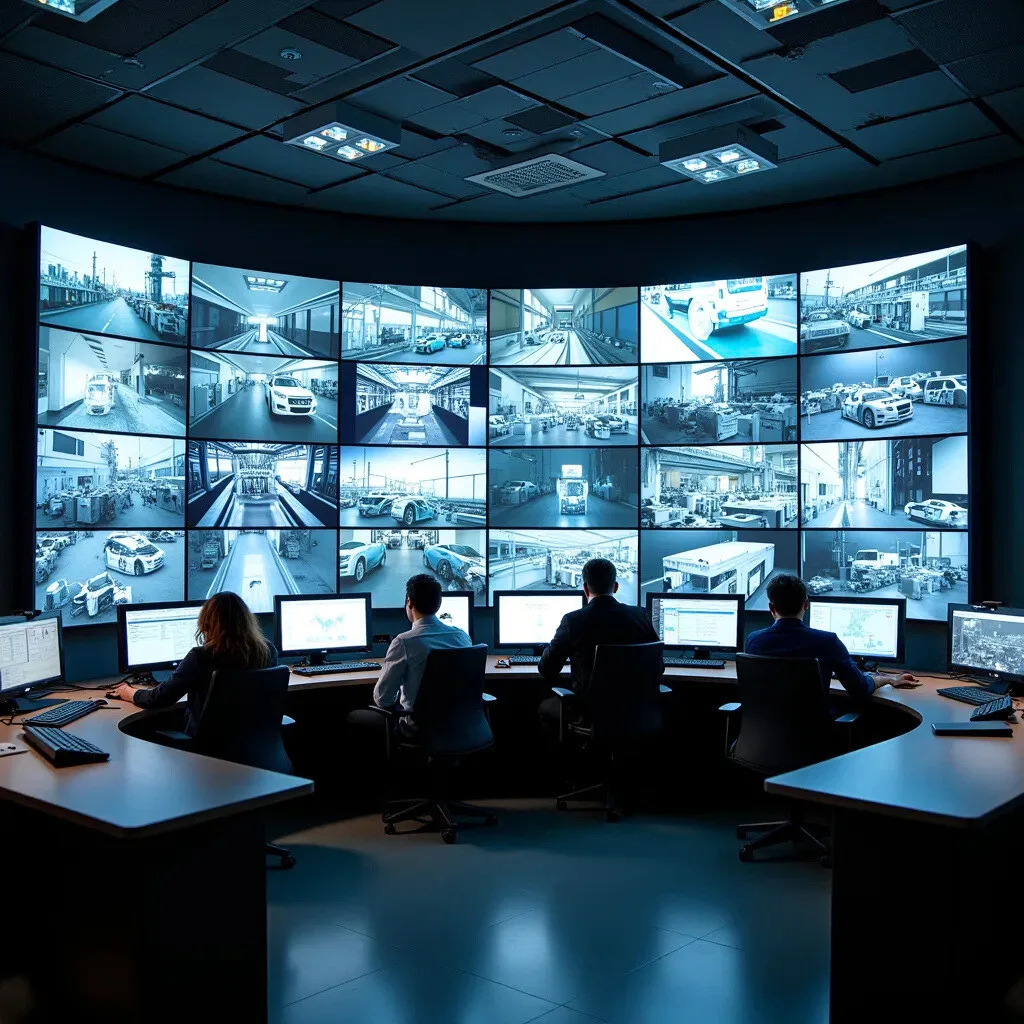
The control console allows a dedicated operator to reconfigure the entire setup in seconds. A new critical update comes in? It can be pushed to the main screen for everyone to see. A coordination call starts with the regional prefect? The video feed moves front and center.
This responsiveness is not just a technical detail. In a room where everyone is tracking different inputs, the video wall creates a shared focus and speeds up collective decision-making.
The video controllers that power these walls also matter. Solutions such as VuWall, Datapath, or Barco dominate the market thanks to their high reliability. Newer players offer fully IP-based, software-driven architectures with greater flexibility, but sometimes at the cost of higher latency. In a DOC, latency is not a minor issue. Delayed map data can lead to poor decisions in fast-moving situations.
Videoconferencing systems also require careful selection. When sensitive information is involved, certified solutions or platforms such as Cisco Webex Government with end-to-end encryption are essential.
Mapping alone is not enough. Decisions need to be tracked, responsibilities assigned, actions monitored, and reports generated. Crisis management platforms such as SYNERGI, widely deployed across French prefectures, or alternatives like Artemis or CODEX, address these needs.
These tools allow each unit to work within a shared environment. When the logistics team orders generators for three municipalities, the intelligence unit sees it instantly and updates its tracking. When the operations director approves an evacuation, the decision is time-stamped, digitally signed, and archived for future review.
This last point is often overlooked. Post-crisis reviews are both a regulatory requirement and a critical learning tool. When used properly, crisis software automatically generates part of the required documentation. That said, this only works if teams are properly trained, which requires regular exercises, not just initial onboarding.
A connected DOC is a target. This is not speculation, it is a documented reality.
According to the ENISA Threat Landscape Report 2023, significant cyber incidents targeting government entities and emergency services in Europe increased by 34 percent between 2021 and 2023. The goal of these attacks is to disrupt crisis response, steal sensitive data, or simply demonstrate capability.
In response, ANSSI has issued specific guidance on securing DOC information systems. Key recommendations include strict network segmentation between internet, operational, and command systems, multi-factor authentication for all sensitive access points, and regular security audits. The good news is that these measures do not require exotic technologies. The challenge is maintaining the discipline and upkeep they demand, especially in time- and budget-constrained environments.
Another, more subtle risk is the accidental introduction of malware through USB drives or personal devices. During a crisis, external actors such as telecom technicians, weather consultants, or accredited journalists may need temporary access to certain systems. Without strict access control policies, the risk of compromise is real.
You cannot set up a DOC just anywhere. Site selection is a strategic decision.
A common contradiction is placing the DOC inside the prefecture building, even when that building sits in a risk-prone area such as a flood zone. A DOC rendered inoperable by flooding is exactly the kind of failure that has occurred in the past, before business continuity planning became more rigorous. Many prefectures have since relocated their crisis rooms to safer, sometimes out-of-town sites, away from identified risks.
Space requirements depend on the scale of the setup, but in practice, a main room of 80 to 150 square meters is a reasonable minimum. Soundproofing is essential. In a crisis, multiple teams operate simultaneously, phones ring, and conversations overlap. Without proper acoustics, the room quickly becomes chaotic.
Additional spaces are also necessary: a rest area for off-duty teams, a separate briefing room for leadership discussions, a secure press area, and adequate sanitary facilities for teams working in 24-hour rotations.
One final detail that is anything but minor: ventilation. In the event of airborne contamination outside, such as a toxic cloud or chemical release, the DOC must be able to operate in positive pressure mode with filtered air for several hours. This requires specialized systems that must be regularly maintained and tested.
More broadly, ISO 11064 provides comprehensive guidance on the layout and ergonomics of control rooms.
A DOC that has not been tested will fail during its first real activation. It may sound blunt, but it is true.
The Directorate General for Civil Security and Crisis Management recommends at least one full-scale exercise per department each year, including full activation of the DOC with all units and partners. In high-risk areas such as the Caribbean, alpine regions, or Mediterranean coastal zones, more frequent exercises are advised.
These exercises serve multiple purposes. They test equipment and inevitably reveal issues such as failing backup power units, outdated radio channels, or missing software installations. They train staff, including newcomers who have never experienced a real crisis. And they validate procedures, often uncovering outdated or unsuitable protocols.
Post-exercise reviews are just as valuable as the exercises themselves. While well established in military and aviation contexts, this feedback culture is still uneven in some civilian administrations. Yet it is in these moments that a DOC’s real resilience is built.
The COVID crisis changed everything, not always for the better.
On one hand, it accelerated modernization. DOCs had to operate partly remotely, with some partners joining via videoconference rather than being physically present. Hybrid collaboration tools were adopted rapidly. The ability to manage long, complex, multi-actor crises was tested in real conditions.
On the other hand, the crisis exposed structural weaknesses: insufficient equipment, procedures not suited to health emergencies, and fragmented information systems that struggled to communicate with each other.
Several trends are shaping the next generation of DOCs. Artificial intelligence is beginning to play a role, particularly in processing large volumes of data such as social media signals, environmental sensor data, or emergency call patterns. Pilot projects are underway in several prefectures. Results remain limited for now, but the potential is clear.
Advanced critical event management platforms are becoming essential, as crises must be anticipated, not just managed. Decision-makers need access to the right information, and only that information, at the right time, in the right place, and in the right format. The goal is simple: keep cognitive capacity focused on analysis and decision-making, not on searching for data.
Cross-border cooperation is another key area. In border regions such as the Pyrenees, the Alps, or northern France, crises may require coordination with Spanish, Italian, or Belgian emergency services. The European Union Civil Protection Mechanism is driving efforts to harmonize procedures and ensure communication system compatibility. This is a long-term effort, but it is underway.
Finally, climate change is reshaping the risk landscape. Events that were once rare, such as megafires, flash floods, or extreme heat exceeding 45°C, are becoming plausible even in regions that were not previously exposed. This forces a rethink of the scenarios underpinning ORSEC plans, and requires DOCs to adapt, re-equip, and retrain for situations they have never faced before.
Paradoxically, the DOC is an ordinary structure. It is a control room, with phones, screens, and people around a table. Nothing about it seems remarkable.
Its value lies in one thing: preparation. A well-equipped, well-trained, and well-organized DOC turns the chaos of a crisis into a structured decision-making process. It does not eliminate uncertainty, no system can, but it creates the conditions for sound decisions to be made within reasonable timeframes, based on the most reliable information available.
In a country increasingly exposed to natural, industrial, and health risks, it is as essential as a hospital or a road network. It deserves the same level of attention, maintenance, and investment.
• DGSCGC – 2022 annual report on civil security, Ministry of the Interior
• ECDC – Technical Report: Crisis Management in Public Health Emergencies, European Centre for Disease Prevention and Control, 2021
• ENISA – Threat Landscape Report 2023, European Union Agency for Cybersecurity

Copyright © 2026. MOTILDE. All rights reserved.