
Spend even a day in Guinea and you can feel it: the country is reinventing itself. Cranes dot the skyline, foreign delegations arrive one after another, and inside government ministries, the talk is all about what’s coming next rather than what’s already happened.
It was against that backdrop that Hubert de Nomazy, Motilde’s director, traveled to Conakry as part of an international business trip organized by Bpifrance. The visit brought meetings with a range of economic and institutional players, including Guinea’s Minister of Transport, Ousmane Gaoual Diallo, centered on the country’s modernization plans.
The trip also gave him a firsthand look at local infrastructure and a chance to talk through the country’s specific needs on the ground. One thing came through clearly: Guinea is a market still being written, and foreign expertise has a real place in it, provided it’s genuine and actually useful to the country’s development.
The Simandou 2040 program is more than a government talking point. Championed by President Mamadi Doumbouya, it sets out a clear ambition: turn the country’s natural resources into serious investment in public infrastructure, give the private sector room to grow, and create jobs that last.
That ambition is already drawing a crowd. Delegations keep landing in Conakry, from the International Finance Corporation, part of the World Bank Group, to UK Export Finance. It’s the same momentum behind the Guinea-France Business Forum, held in Conakry and co-organized by the Ministry of Planning, International Cooperation and Development alongside Bpifrance.
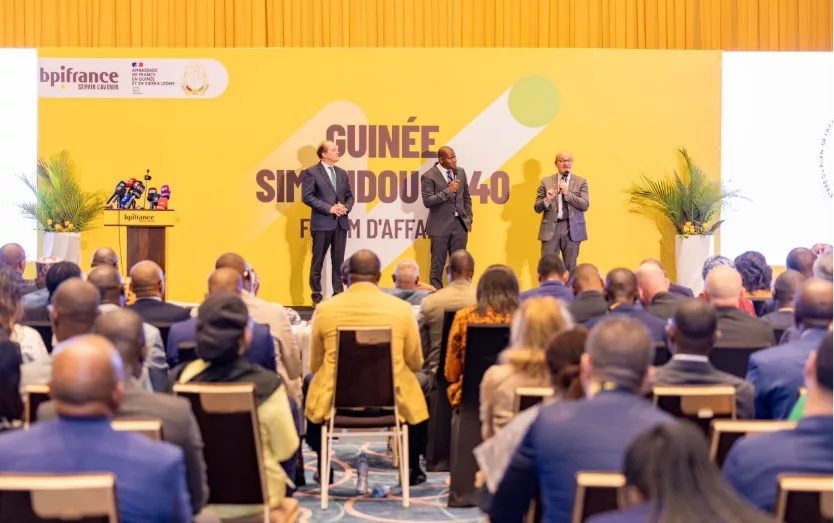
Taken together, these events paint the picture of a country working hard to look like a credible place to invest, backed by promised reforms to make doing business easier. That open-door stance is meant to help close gaps that are still huge across the board: energy, water, agriculture, digital infrastructure, transport. And pushing all of it forward is a young, fast-growing population on the ground.
Spend a few hours at the Autonomous Port of Conakry, as Hubert de Nomazy did on his visit, and you get a real feel for what the teams there are up against every day. Traffic is climbing fast, operations are getting more complicated, and security pressure keeps building, especially around compliance with the ISPS Code, the international framework for ship and port security that the International Maritime Organization introduced after September 11, 2001. On the ground, that means cameras that need watching, access points that need controlling, sensors that need reading, and operations that need overseeing, a patchwork of tools bolted on over the years, with no single view tying it all together yet.
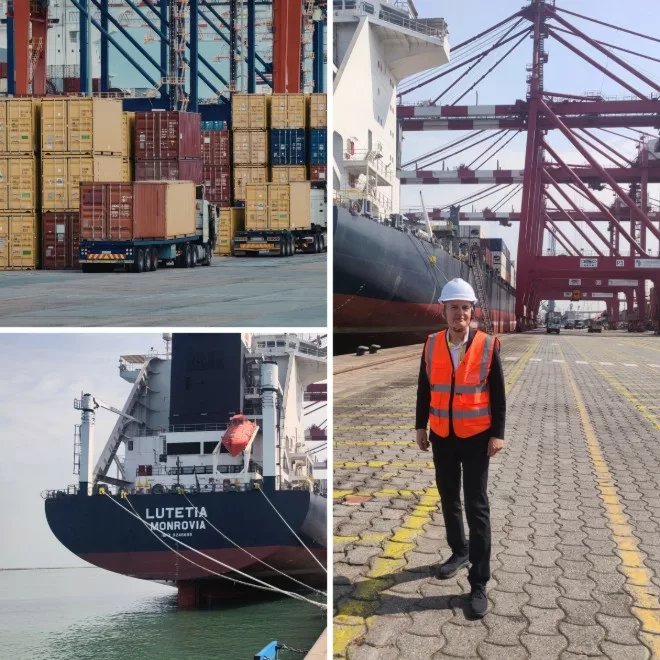
And Conakry isn’t an outlier. UNCTAD‘s 2025 report on maritime transport points out that over 80% of global goods trade travels by sea, and that share climbs even higher for developing countries. The same report found that African ports posted the fastest growth in maritime connectivity anywhere in the world in 2025, driven in large part by traffic rerouted away from the Red Sea.
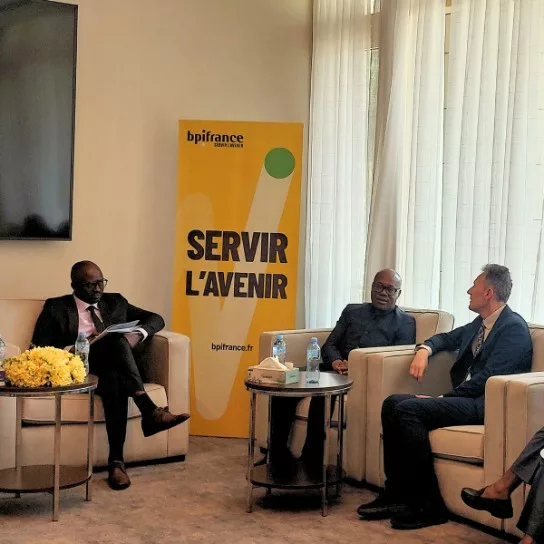
Before touring the port, Hubert de Nomazy sat down one-on-one with Transport Minister Ousmane Gaoual Diallo to talk through projects still taking shape, among them ARTFM’s monitoring center. Conversations like that, informal as they are, tend to reveal more about local priorities than any brochure could, much like walking the site itself. Ports, aviation, rail, roads: Guinea’s government has an ambitious roadmap on its hands, one that builds directly on reforms already set in motion in recent years.
A port, an energy site, a land transport hub: different worlds, same underlying problem. Each has operational and security systems stacked on top of each other over the years, throwing off valuable data that too often goes nowhere useful because nothing ties it to what actually matters in the moment. A camera catches suspicious movement while, somewhere else on-site, a sensor flags something off, and there’s no time to connect the two before it’s too late. Bring those signals together under one system that actually links them, and suddenly they mean something again, and the response comes that much faster.
The financial side of this gets underestimated just as often. A breakdown that drags on, a flow that isn’t managed well, an alert that gets picked up too late: every one of those delays costs money, whether that’s a ship sitting idle at the dock, a production line standing still, or a project falling behind. A full view of what’s happening across operations means spotting trouble before it turns into a genuine crisis.
The companies that do well in Guinea aren’t the fastest movers, they’re the ones willing to get it right. That starts with building a real presence on the ground instead of dropping in every so often. From there, it means taking the country’s actual operating conditions seriously, logistics, integration with systems already in place, the climate, none of which can be an afterthought. And finally, it comes down to real local partnerships: the one between Motilde and MouNa Group Technology, a fast-growing Guinean company, is a good case in point.
Simandou 2040 gives Guinea’s economy a clear sense of direction, built around natural resources, public infrastructure, and private sector growth. That alone was enough to bring in the International Finance Corporation, UK Export Finance, and the Guinea-France Business Forum, all within a few months of each other. Add to that a growth rate among the highest anywhere in the world, with projections putting 2026 above 10%.
Rising traffic, operations that are only getting harder to manage, and security demands under the ISPS Code that keep tightening, all while there’s constant pressure to cut down how long ships sit at the dock.
Because nothing there has settled into place yet. Infrastructure, day-to-day practices, and regulatory frameworks are still being worked out across several sectors, which leaves real room for anyone willing to get in early, rather than a fixed spot to compete for in a market that’s already been carved up.

Copyright © 2026. MOTILDE. All rights reserved.