
Since its launch in 2015, the NDI protocol has introduced a standardized approach to video transmission over IP, leveraging standard Ethernet networks.
While this technology offers clear advantages for certain applications, it is important to take an objective look at its actual position in the professional monitoring market and at the alternatives favored by major industry players.
NDI (Network Device Interface) is a video-over-IP protocol that enables the transmission of video, audio, and metadata streams with low latency over a standard Ethernet network.
Developed by NewTek, now part of Vizrt Group, this standard aims to simplify how professionals capture, transmit, and deliver real-time video content.
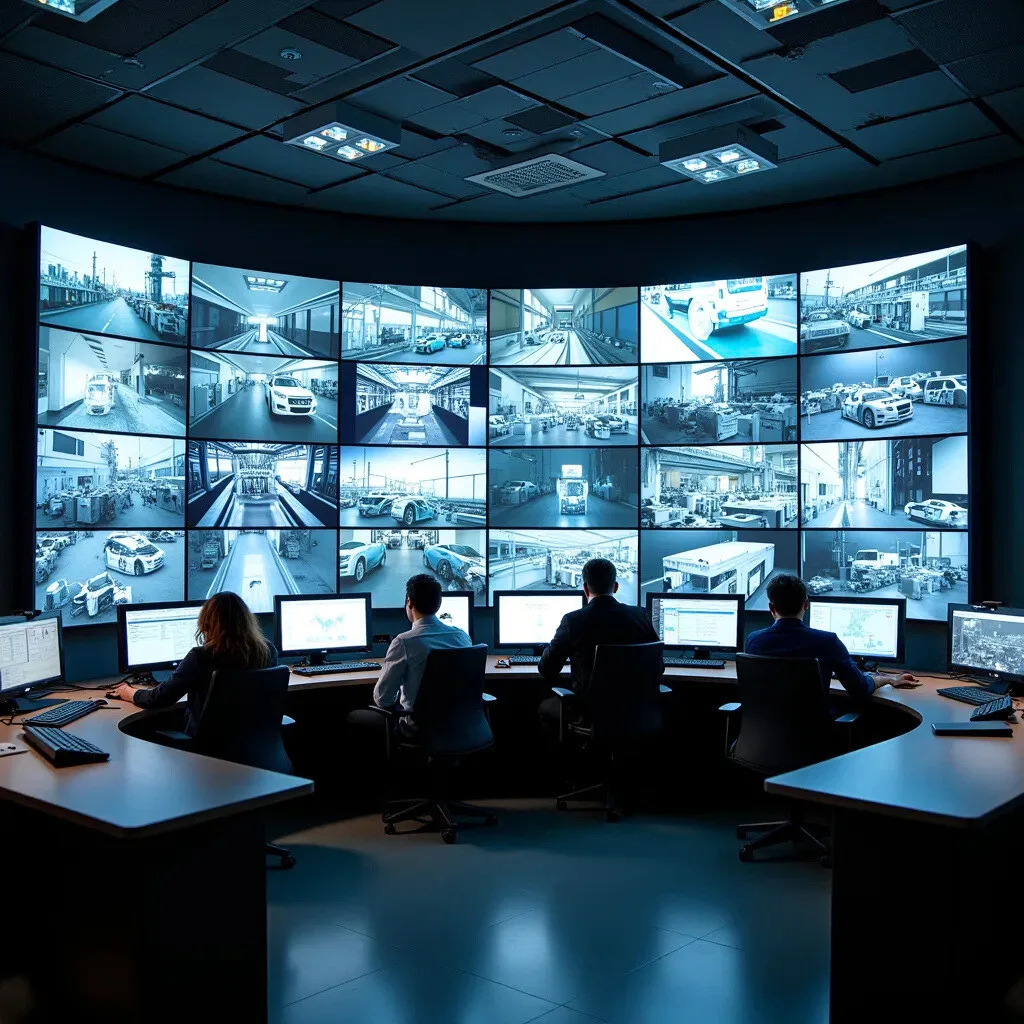
In monitoring environments, it allows operators to view dozens or even hundreds of video sources simultaneously without requiring the costly and rigid infrastructure of traditional systems.
The NDI protocol uses a video compression algorithm that maintains excellent visual quality while reducing bandwidth requirements.
This efficient compression makes it possible to transmit high-definition video streams with latency below a single frame, typically around 16 milliseconds for 1080p at 60 frames per second. This level of performance makes NDI particularly well suited to live production workflows and time-critical environments.
The technology is based on automatic source discovery across the network. As soon as an NDI-compatible device connects, it becomes instantly visible to all other NDI-enabled equipment. This eliminates the need for complex configuration.
NDI is available in several versions designed for different use cases. NDI|HX, for instance, uses higher compression based on H.264 or H.265 to further reduce bandwidth consumption.
According to figures published by Vizrt Group in 2024, more than 2,000 products from over 600 manufacturers support NDI in one form or another.
NDI 5, released in 2020, introduced features such as HDR support (which requires the paid Advanced SDK), improved metadata handling, and enhanced performance for high-capacity networks.
One of NDI’s main strengths is its ease of implementation. Unlike traditional systems that require complex setup, NDI relies on automatic source discovery via mDNS. Connect an NDI-compatible device to the network, and it becomes immediately visible to all other devices on the same subnet, with no manual configuration required.
This plug-and-play approach significantly reduces deployment time and eliminates common configuration errors. For integrators, this means faster commissioning and less post-installation support.
In a control room, this simplicity allows operators to quickly reconfigure their displays without technical assistance. A supervisor can add a new camera or dashboard to a video wall simply by connecting it to the network, and it will instantly appear among the available sources.
NDI redefines traditional video routing. Instead of fixed connections between inputs and outputs, any screen or application connected to the network can display any available source at any time, with no physical limitations.
This software-based architecture offers a level of flexibility that wired systems cannot match. A single stream can be displayed on multiple screens, recorded, analyzed, and distributed simultaneously without additional hardware.
In a control room, this flexibility transforms operations. During an incident, operators can instantly reorganize their displays, focus multiple screens on a critical area, share a specific view with a remote colleague, or switch between predefined layouts as the situation evolves, all without waiting for a technician to rewire anything.
Expanding an NDI system simply requires adding more network connections. This organic scalability allows organizations to grow their monitoring infrastructure in line with actual needs, without heavy upfront investment.
For small to mid-sized installations, NDI offers a clear cost advantage. An IP-based network infrastructure built on standard managed Gigabit switches is significantly less expensive than an equivalent professional video matrix. While a 32×32 matrix can cost between €50,000 and €150,000, a comparable network setup typically ranges from €5,000 to €15,000.
Cabling is another major source of savings. Widely available Cat6a Ethernet cables cost a fraction of professional video cables with comparable performance. Across dozens of connections, this results in substantial cost reductions.
For control rooms with limited budgets, these savings can be redirected toward other critical components such as higher-quality displays, video analytics systems, operator training, or preventive maintenance. NDI helps make advanced monitoring technologies accessible to organizations that previously could not afford them.
VuWall has integrated NDI support into its video wall management solutions, allowing NDI sources to be displayed alongside other protocols.
For example, the VuWall TRx platform can ingest NDI streams while relying on its own proprietary protocol for advanced features.
This multi-protocol approach enables VuWall to address a wide range of customer needs, with NDI serving as one option within a broader architecture.
Major manufacturers such as Barco, Datapath, and Matrox have developed their own AVoIP ecosystems, often based on proprietary protocols optimized for their specific applications:
Vizrt Group provides a free suite called NDI Tools, including NDI Studio Monitor for viewing individual streams and NDI Screen Capture for turning any computer into an NDI source.
Despite its advantages, NDI has not become the universal standard in professional monitoring environments. Several factors explain this.
Critical video walls require frame-accurate synchronization with microsecond precision, network genlock, and fully deterministic behavior at scale. As a result, the industry largely relies on standards such as SMPTE ST 2110 (with PTP/IEEE 1588 via ST 2059), as well as SDVoE and JPEG XS ecosystems that deliver ultra-low latency.
NDI does offer a software-based genlock feature, but it is not built around PTP like ST 2110. For critical applications, integrators consistently prefer standards that guarantee deterministic performance.
Many deployed NDI streams use NDI|HX (H.264/H.265 encoding in 8-bit 4:2:0) to reduce bandwidth. This does not meet the requirements of environments that demand 10-bit, 4:4:4, or broadcast-grade HDR quality.
In addition, full HDR output requires the paid NDI Advanced SDK, which limits default adoption in integration projects.
Video wall controllers often need to handle HDCP 2.x-protected sources such as set-top boxes, media players, or Apple TV devices. HDCP support in NDI has only been demonstrated in limited environments as of 2025, without widespread deployment, whereas SDVoE, JPEG XS, and proprietary solutions already support content protection reliably.
By default, NDI uses mDNS for source discovery, a protocol designed for local networks and not well suited to routing across subnets. While this limitation can be addressed with an NDI Discovery Server, it introduces additional network engineering complexity that professional AVoIP solutions typically avoid through standards like NMOS or integrated control systems.
For multi-site or geographically distributed installations, this architectural limitation becomes a significant constraint.
Major AVoIP vendors have heavily invested in their own hardware and software stacks, already validated and optimized for KVM, HDCP, and synchronized video walls:
In this context, NDI may be supported through conversion gateways, but it is not the primary technology used for the most demanding applications.
Rather than being dominated by a single protocol, the industry is moving toward a coexistence of multiple standards, each optimized for specific use cases. Professional solutions increasingly support multiple protocols, allowing the most suitable one to be selected for each source and application.
Improved interoperability between NDI, SMPTE ST 2110, SDVoE, and other IP-based protocols is becoming a key priority. Conversion gateways and hybrid solutions enable organizations to benefit from each technology without being locked into a single ecosystem.
Regardless of the transport protocol, the integration of artificial intelligence into monitoring systems is a major trend. Video analytics algorithms can automatically detect relevant events and optimize video wall displays, regardless of the underlying transmission technology.
NDI is a compelling option for certain monitoring applications, particularly in smaller or non-critical environments where ease of deployment and affordability are key advantages.
However, when monitoring systems become mission-critical and require deterministic synchronization, high color depth, reliable HDCP support, or large-scale scalability, professionals tend to rely on other standards. SMPTE ST 2110, SDVoE, and proprietary solutions from major manufacturers remain the preferred choices.
The real question is not whether NDI will replace other technologies, but which standard, or combination of standards, best meets the requirements of your specific installation.
At Motilde, our experts support you in selecting and deploying the AVoIP solution that best fits your needs, whether it involves NDI, SMPTE ST 2110, SDVoE, or hybrid architectures. We analyze your technical, budgetary, and operational constraints to recommend the optimal infrastructure. Contact us for a tailored audit.

Copyright © 2026. MOTILDE. All rights reserved.