Our experience spans two dedicated websites.
Discover the world of Collaborative and Meeting Spaces:
Discover the world of Collaborative and Meeting Spaces:

A flight delayed by fifteen minutes doesn’t cost fifteen minutes. It pushes back a rotation. It ties up a gate for longer. It throws the ramp team off schedule and lengthens the queue at security. From there, the effect ripples out across the network.
The Airport Operations Center, or airport operations centre, was designed to break that chain. A single place where data, stakeholders and decisions come together in real time.
For a long time the preserve of major hubs, the APOC is now reaching mid-sized platforms. Which leaves the question operations directors keep asking: what actually sits behind the acronym, and how do you design a room that delivers on the promise?
Key takeaways
An APOC centralises the monitoring, forecasting and coordination of a platform’s operations. Flights, passengers, baggage, aircraft stands, staffing, maintenance: everything that shapes the operating day converges there.
The point is not to add another layer of hierarchy. It is to remove blind spots. Each stakeholder normally works from its own operational truth, drawn from its own system. The APOC imposes a shared reading of the situation, and the nature of the trade-offs changes as a result.
Nice Côte d’Azur is a good illustration. Its APOC occupies a 500 m² floor fitted with dozens of control screens. A hypervisor supports real-time management of the full operation, under the authority of an Airport Duty Manager created for the purpose. Brussels-Zaventem led the way back in 2015, turning its APOC into the platform’s operational nerve centre.
The confusion comes up often. The control tower belongs to the air navigation service provider and manages aircraft movements. The AOCC has historically focused on day-to-day execution on the operator’s side.
The APOC widens the frame. It covers both airside and landside, from D-1 planning through to the post-operations debrief. Its purpose comes down to one idea: collaborative decision-making.
The APOC didn’t appear out of nowhere. It grew out of Airport Collaborative Decision Making, a method for sharing information between partners. A-CDM is now fully deployed at 34 European airports, including Paris-CDG, Paris-Orly, Lyon, Nice, Frankfurt, Amsterdam, Madrid and Zurich. In SESAR’s work, the Airport Operations Plan served to strengthen situational awareness, with the APOC supporting the collaborative decision-making process.
That single plan, validated by every partner, links to the Network Manager’s network plan. The Total Airport Management programme sums up the direction of travel: moving from reactive to anticipatory operations.
Recent figures put the stakes in perspective. In 2025, the European network recorded 11.12 million flights, 4% more than in 2024. Arrival punctuality reached 76.1% and ATFM delays fell by 17% per flight. EUROCONTROL credits the improvement to better coordination between stakeholders, proactive measures and milder weather (EUROCONTROL, European Aviation Overview).
The economic side remains heavy. According to IATA, air traffic control delays in Europe account for €17.5 billion in costs, of which €10.9 billion falls on airlines and €6.6 billion on passengers (IATA, Air traffic control delays in Europe).
An airport has no control over airspace capacity. It does control its turnarounds, its stands and its passenger flows. That is precisely an APOC’s playing field.
The other benefit is harder to quantify. It concerns IROPS: severe weather, baggage system failure, a security incident, an unexpected surge.
The Brussels experience is telling. In a crisis, all stakeholders assess the situation together, in the same room. A coordinated action and communication plan is rolled out, with two priorities: keeping the operation running and looking after passengers.
The principle is straightforward. A room used every day in normal mode naturally becomes the command post in crisis mode. No improvised ramp-up, no learning under pressure.
The make-up varies from one platform to another, though a common pattern emerges.
| Function | Role in the APOC | Critical data tracked |
|---|---|---|
| Airport Duty Manager | Overall arbitration, authority in a crisis | Deviations from the operating plan |
| Airside and stand allocation | Assignment, sequencing | Stand occupancy, TOBT |
| Passenger flows | Security, borders, boarding | Waiting times at each processing point |
| Baggage | Sorting and transfers | System alarms, incident rates |
| Airlines and ground handlers | Turnaround resources, rotations | Turnaround times, available staffing |
| Technical maintenance | Equipment availability | BMS alarms, airbridges, belts |
| Security and cybersecurity | Incidents, systems continuity | Alerts, SIEM events |
The indicators recorded by EUROCONTROL across European APOCs cover A-CDM milestones, delays and their causes, the capacity-demand balance on the runway, and waiting times in passenger and baggage processes.
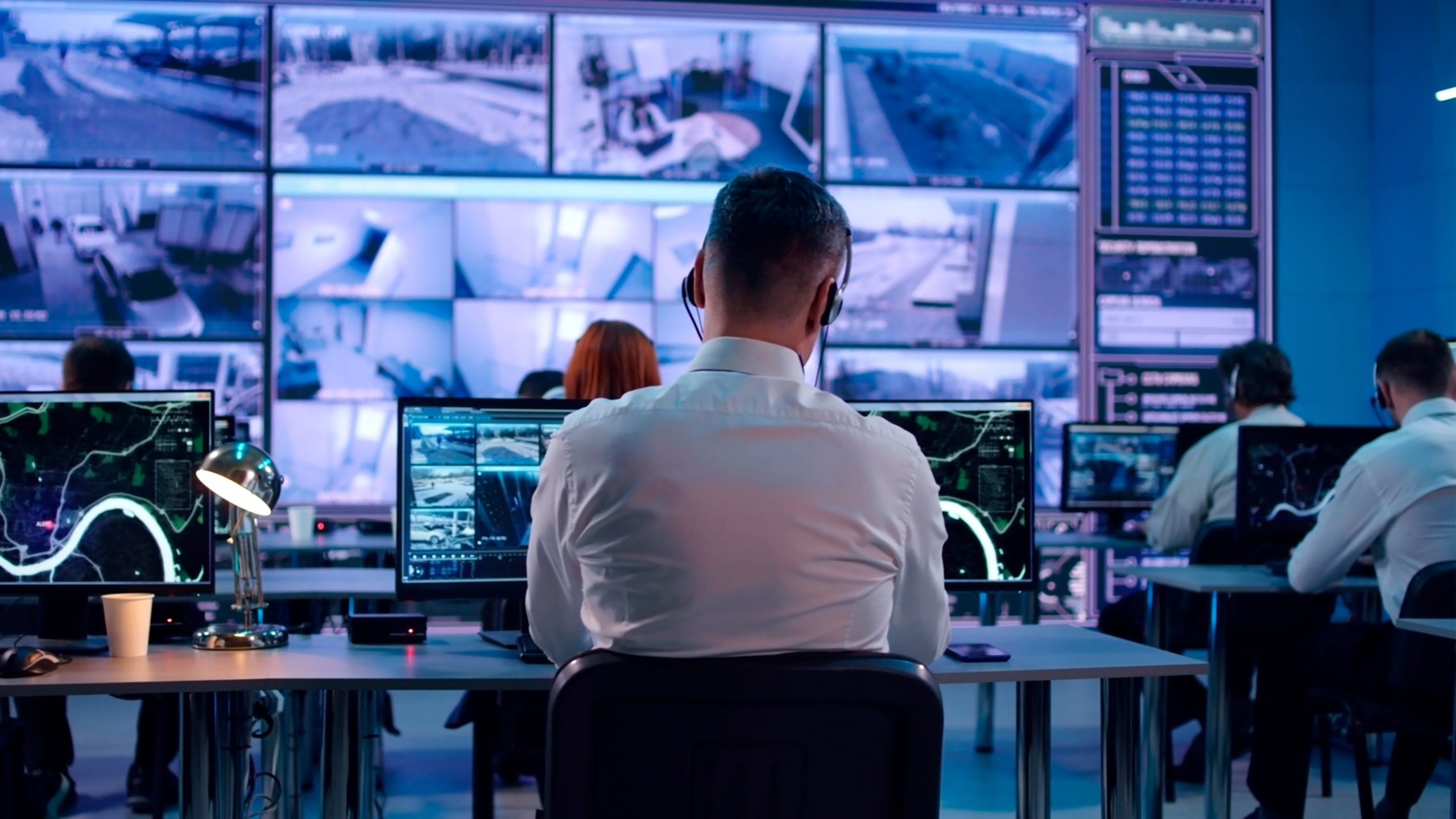
An APOC is first and foremost a control room in continuous operation. Design mistakes are paid for in operator fatigue, and therefore in poor decisions.
The video wall shapes collective situational awareness. Three parameters dominate:
Fine-pitch LED now dominates large surfaces. No seams, consistent imagery, long service life.
The classic mistake is sizing the surface before defining the views. A good video wall displays few things, but the right ones: flight synoptic, stand mapping, queue curves, active alarms.
A position staffed continuously calls for a workstation built for the long haul. Height adjustment, thermal management, integrated cabling, controlled viewing angles across three to six screens.
The ISO 11064 standard, which covers the ergonomic design of control centres, provides a solid framework for layout and fields of view.
Technical furniture is not a budget adjustment variable. It determines how alert operators remain at the end of a shift. And therefore the quality of decisions at three in the morning.
An APOC is noisy by nature. Radio calls, overlapping conversations, constant coordination between clusters. Acoustic treatment and workstation orientation determine how well people can concentrate.
Business continuity is planned from the design stage onwards. Backup power, redundant video and network chains, a fallback position able to take over essential functions. Integrators specialising in control rooms and supervision centres (such as Motilde) typically step in at this point, tying together ergonomics, audiovisual systems and operational requirements.
The first is expecting technology to generate collaboration. Putting screens in a room isn’t enough. Partners also need a reason to adjust their plans together.
The second is information overload. Too many views on display drown out weak signals. The effect achieved is the opposite of the one intended.
The third overlooks the human factor. A spectacular but uncomfortable room gradually empties out. Everyone drifts back to their own office. And an APOC only exists if people are in it.
Three developments are shaping recent projects.
SESAR is also working on adapting airport operations management solutions to regional airports. The APOC approach therefore extends well beyond the circle of major hubs.
A-CDM is a method. It organises information sharing and the synchronisation of departure processes between partners. The APOC is where that collaboration takes physical shape, across a broader scope that includes passengers, baggage and resources.
There is no universal threshold. The real criterion is complexity: the number of stakeholders to coordinate, the share of transfer traffic, sensitivity to disruption. Airports handling a few million passengers deploy lighter set-ups built on exactly the same logic.
Twelve to twenty-four months, depending on the scale of the works and the depth of integration. Defining processes and governance is often the critical path, more so than the technical rollout.
Most are staffed in line with operating hours. A reduced team overnight, scaling up at peak times or during a crisis. The room has to be designed for both regimes.
On-time departure performance, taxi times, TOBT compliance, waiting times at checkpoints, late stand changes, and how quickly normal operations resume after an incident.
The Airport Operations Center answers an equation that had become unworkable. More traffic, thinner margins, no tolerance for service disruption. Its value lies not in the screens, but in the ability to bring stakeholders with different interests around to a single reading of the day.
The coming years will shift the emphasis from reaction to anticipation. Simulation, prediction and network integration will turn the airport operations centre into a genuine management tool. The task will no longer be simply to handle the incident in front of you, but to steer performance over the hours ahead. Platforms that invested early in governance, and not only in technology, will be a step ahead.

Copyright © 2026. MOTILDE. All rights reserved.