
The fire control room is the nerve centre of every fire and rescue service. It is where 999 and 112 calls for the fire service are answered, where appliances are mobilised and where incidents are supported from the first ring to the last crew returning to station. It runs 24/7, has to absorb sudden surges in demand and must remain readable in the middle of a major incident. For Motilde, which designs and equips control rooms, it is one of the most demanding environments there is: every design decision has a direct impact on the quality of the emergency response.
Key takeaways
Behind the single word “Control”, fire controls carry out two distinct jobs, even though the same team usually does both.
The first mission is to answer calls. When a member of the public dials 999 or 112 and asks for the fire service, the call is put through to the fire control room covering that area. Within a few dozen seconds, the operator has to understand what is happening, locate the caller and assess the risk. They then mobilise the appropriate resources. In some cases, they also give safety advice over the phone, including fire survival guidance to people trapped in a building, or pass the call to the police or ambulance service when the request falls within their remit.
Under the Fire and Rescue Services Act 2004, every fire and rescue authority must make arrangements for dealing with calls for help. In practice, that responsibility sits with the fire control room.
The second mission begins once crews are on the move. The control room tracks appliances, keeps a watch on cover across the service area, sends additional resources when an incident escalates and acts as the link between the incident commander and the rest of the service. When a major incident is declared, it also feeds information to partner agencies and to multi-agency coordination arrangements.
The difference can be summed up simply: call handling works minute by minute, while mobilising and incident support work incident by incident, sometimes across an entire crisis.
| Mission | What it involves | Time horizon |
|---|---|---|
| Call handling | Answer, assess and process the 999 call, give safety advice | The first few minutes |
| Mobilising and incident support | Mobilise resources, monitor incidents, manage cover, inform partners | The full duration of the incident or crisis |
A fire control room runs with a small team and clearly defined roles. Most services organise Control on a watch system that mirrors operational fire stations, with Control Operators handling calls and radio traffic, Crew Managers supervising activity, and a Watch Manager in charge of the room. Senior control officers and the service’s duty officers take over when an incident escalates.
Humberside Fire and Rescue Service gives a clear example of how a control room is staffed. Its Control Room works on four watches (Blue, Green, Red and White), alternating two day shifts and two night shifts, and each watch is made up of a Watch Manager, two Crew Managers and three Control Operators. In some services, roles are fully interchangeable: at Bedfordshire Fire and Rescue Service, a watch commander explains that the multi-disciplinary control team can each handle a 999 call, an admin call or a radio message, and command an incident.
The volume of work is considerable. In the 12 months to September 2025, Essex County Fire and Rescue Service operators handled around 34,000 calls, more than 90 a day on average, a figure that has risen by around 30 per cent. Behind that average lie quiet nights and days when calls arrive in waves. The same Bedfordshire watch commander notes that a single car fire on the M1 can generate 60 calls in the space of just 10 minutes.
This is probably the factor that weighs most heavily on fire control room design. A control room does not always run at the same level. During a heatwave, a storm or a flood, demand can multiply within an hour. At the Scottish Fire and Rescue Service’s Johnstone Control Room, a siren sounds when there is an influx of calls, and staff on breaks run back to their seats to help.
Fire controls also rely on each other. HM Inspectorate of Constabulary and Fire & Rescue Services reports that some control room operators worried about handling large call volumes, but felt confident that the buddy system, which pairs fire control teams from different services, would support them effectively.
For Motilde, this staged approach should shape every fit-out project. A room designed for a handful of night-shift operators must be able to accommodate recalled staff within minutes, without anyone hunting for a power socket, a screen or a free seat at a console.
The image of a fire engine racing to a blaze is hard to shake, but it reflects only part of the workload. In England, fire and rescue services attended 642,264 incidents in the year ending December 2025, a 6.8% increase on the previous year, including 175,918 fires. Fires accounted for 27% of incidents, fire false alarms for 39% and non-fire incidents for 33%, compared with 32%, 41% and 27% respectively ten years earlier (source: MHCLG, Fire and rescue incident statistics, year ending December 2025).
Non-fire incidents reached a record level. The 214,184 non-fire incidents attended were the highest number since the online Incident Recording System was introduced in 2009. Road traffic collisions, flooding, assisting other agencies and gaining entry for the ambulance service all go through the fire control room. This growing diversity explains why links with police and ambulance control rooms matter so much, and with them, the communication tools between control rooms.
For decades, the radio link between crews and control rooms has relied on Airwave. According to the National Audit Office, all 108 police, fire and ambulance services across England, Scotland and Wales use this critical network to communicate between the field and control rooms. Its replacement, the Emergency Services Network (ESN), is being delivered by the Home Office through the Emergency Services Mobile Communications Programme.
The programme has been delayed many times. The adoption date for ESN has been pushed back to 2029, leading the Home Office to explore options to extend the life of Airwave. For control rooms, the switchover is still coming, and it will bring new voice and data services into the operator’s working environment.
The topic is often approached from an IT angle. From Motilde’s perspective, it concerns the room itself just as much. A new radio system or mobilising system means a different window layout on screen and different information to share on the video wall. Sometimes it also means rethinking the operator console. Services planning a mobilising system upgrade or preparing for ESN would do well to review their control room equipment at the same time, rather than adding screens after the fact.
Fire controls have also been shaped by the debate over centralisation. The FiReControl project aimed to replace the 46 local control rooms of England’s fire and rescue services with nine purpose-built regional centres linked by a new IT system, and the National Audit Office judged it a comprehensive failure. At least £469m was wasted before ministers scrapped the project (source: National Audit Office, The failure of the FiReControl project, July 2011).
Today, collaboration tends to take more flexible forms. Suffolk Fire and Rescue Service’s new control room, which went live in June 2025, is part of a wider hub with Hertfordshire and Norfolk, allowing the three teams to support each other during busy periods. Shared platforms and buddy arrangements require control rooms that are designed to work together, not just side by side.
The Grenfell Tower fire has also had a lasting impact on fire control rooms. The Grenfell Tower Inquiry’s Phase 1 report, published in October 2019, made recommendations to improve how fire and rescue services respond to major incidents. Following the fire, the National Fire Chiefs Council produced the first suite of national fire control guidance. Control staff now work to the Fire Control Fire Standard and National Operational Guidance for Fire Control.
Some of these changes directly affect the room. London Fire Brigade, for instance, launched a Fire Survival Guidance application that displays information from fire survival calls at the incident ground and in the control room at the same time. Information-sharing tools of this kind need space on the operator’s screens and on the shared displays.
A fire control room combines every constraint found in a critical control room. Round-the-clock operation, constant communications, high cognitive load and zero tolerance for failure: every design choice is measured against these requirements.
An operator may spend twelve hours at their position, by day or by night. Several screens, telephony, radio and sometimes a tablet or touchscreen all compete for space on the work surface. Without careful planning, the console quickly becomes cluttered and the operator ends up craning their neck to follow events.
Motilde always designs the control room around the operator position, never the other way round. Adjustable height, sit-stand working, screen viewing distances and seating designed for 24/7 use: these details determine how alert operators remain at the end of a night shift. The ISO 11064 standard, which covers the ergonomic design of control centres, provides the framework.
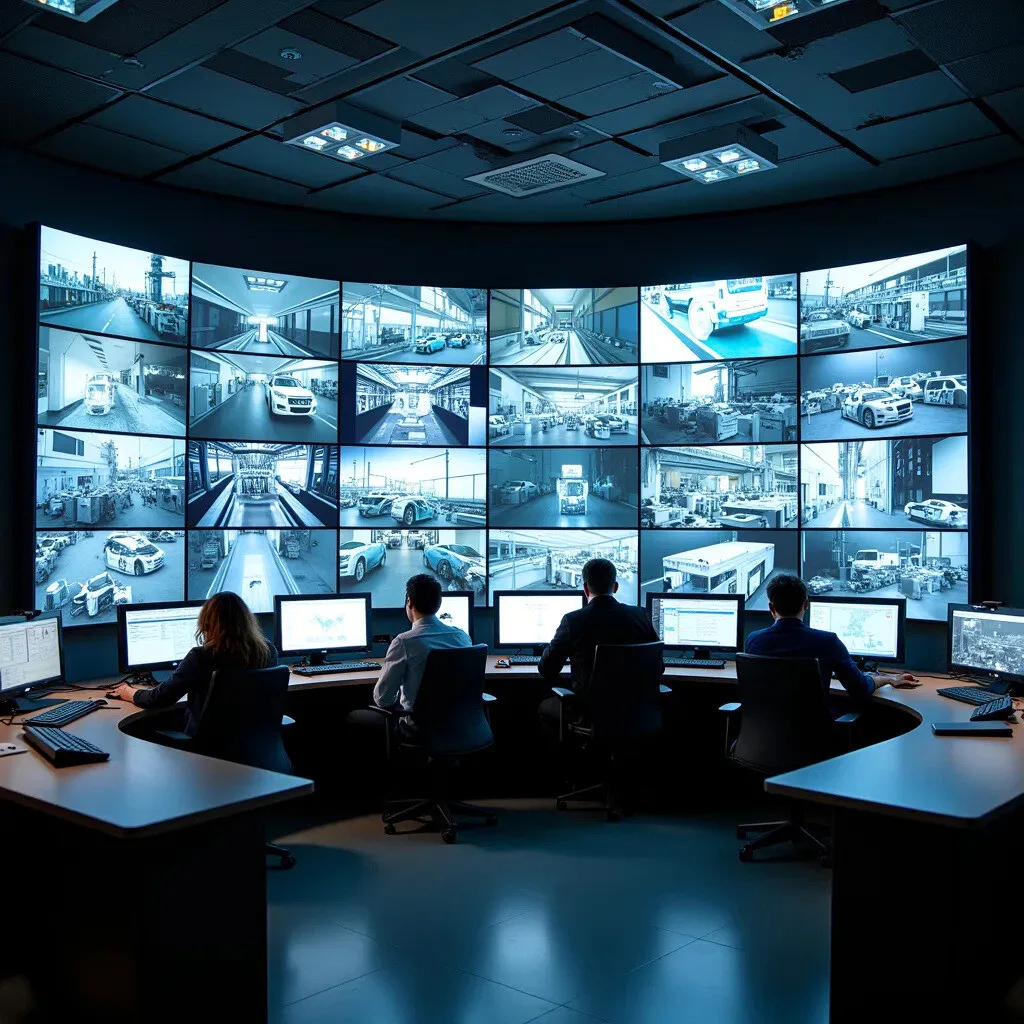
In a fire control room, the video wall ensures that everyone sees the same thing at the same time. It displays the map of incidents in progress, appliance availability and station cover, weather warnings and sometimes footage from a drone or a camera. During a wildfire or a flood, this shared picture saves a great deal of unnecessary back-and-forth.
It still has to be readable from every position, including the furthest one. Size, resolution and, above all, how content is organised matter more than the display technology itself. A video wall crowded with windows helps no one.
In a fire control room, the voice is the main working tool. Several operators speak at once, often to callers in distress, while radio traffic plays in the background. In a reverberant room, everyone ends up raising their voice, callers find it harder to understand and fatigue sets in faster.
Yet acoustics is a budget line that is often trimmed. Acoustic treatment for walls and ceilings, adequate spacing between positions and high-quality professional headsets make a profound difference to working comfort, and to the quality of conversations with callers.
When a major incident develops, senior officers need to be able to meet without drowning out the operators. A glazed command room adjoining the control room maintains visual contact with activity while keeping discussions separate. It is equipped like a crisis room: shared displays, video conferencing with partner agencies and fast document sharing.
Business continuity is not optional in a fire control room. It relies on backed-up power supplies, duplicated network equipment and interchangeable positions. Most services also maintain a fallback control site ready to take over, as well as arrangements with buddy controls. Moving computers into a dedicated equipment room using KVM solutions also makes it possible to maintain hardware without disturbing operators or interrupting operations.
Before refurbishing or building a fire control room, a few questions help define the requirement:
The most frequent mistake is to size the room for an ordinary night. It works perfectly ten months out of twelve, then becomes overcrowded during a heatwave or a flood. Surge positions must physically exist, cabled and ready for use, even if they remain empty most of the time.
Another common drift is to add a screen for every new tool. After a few years, the operator faces a row of monitors with no hierarchy, and critical information gets lost. Clearly dividing content between console screens and the video wall prevents this build-up.
Night work is also often underestimated. Dimmable lighting with no glare on the screens, and a rest area close by, make a real difference for watches working long shifts.
Then there is the question of the works themselves. Refurbishing a fire control room almost always happens on a live site, since the room cannot close. Phasing, with a temporary room or a switchover to the fallback control, must be planned at design stage, not discovered on the day work begins.
A fire control room project involves many disciplines: architect, ergonomist, technical furniture manufacturer, AV integrator, IT teams and the mobilising system supplier. The risk is that each one optimises their own part without seeing the whole picture.
Motilde’s role is precisely to hold that thread together, from listening to operators through to commissioning. This approach draws on experience gained in similar environments, such as urban video surveillance centres and crisis management rooms, where availability and clarity of information are just as decisive.
The move to ESN and the renewal of mobilising systems will change the tools operators use every day. Fire control rooms will need to keep pace, with consoles and displays adapted to new voice and data services.
Information sources are also multiplying: videos sent by callers, drone footage, sensors and live weather data. Without a clear view of what deserves to be displayed, and to whom, this abundance can quickly overwhelm operators. Hypervision tools help bring these feeds together into a single, coherent view.
Extreme weather is another pressure point. The hot, dry summer of 2025 drove a rise in outdoor fires, and secondary fires increased by 46% on the previous year. Such peaks strengthen the case for overflow positions and mutual support between controls. At the same time, operator wellbeing, between night work and distressing calls, is becoming an issue in its own right. Control room design is one of the most tangible levers for addressing it.
A fire control room is the operational centre of a fire and rescue service. It answers 999 and 112 calls for the fire service, mobilises appliances and crews, and supports incident commanders until the incident is closed. It operates 24 hours a day, 365 days a year.
Call handling covers the first few minutes: answering the call, assessing the situation and giving safety advice. Mobilising and incident support take over for the duration of the incident. Control monitors crews, sends additional resources, manages cover across the area and keeps partner agencies informed.
Control Operators handle calls and radio traffic, Crew Managers supervise activity and a Watch Manager runs the room on each shift. Senior control officers and duty officers take over during major incidents. Staffing levels vary depending on the size of the service and the level of demand.
The Emergency Services Network (ESN) is the critical communications system being delivered by the Home Office to replace Airwave, the radio network used by police, fire and ambulance services to communicate between the field and control rooms. Its roll-out has been delayed several times.
Start with the operator console, designed for continuous 24/7 work, then organise a video wall that is readable from every position. Acoustic treatment and redundancy for all critical equipment come next. An adjoining command room, a fallback control and buddy arrangements complete the set-up.
Off-duty or on-break staff can be called back to their positions, and calls can be handled by a partner control under buddy arrangements. Some services also share a control platform with neighbouring services so that teams can support each other during busy periods.
The fire control room is the point of entry for every call for help made to the fire and rescue service, and the nerve centre of its operations. Its performance depends first and foremost on the people who work there. It also depends heavily on their environment: a well-designed console, a room where people can hear each other, and displays that clarify the situation rather than cloud it.
In the coming years, the move to ESN, the influx of new information sources and the growing number of weather-related emergencies will transform these rooms. For Motilde, the right approach is to design fire control rooms today that can evolve, with modular consoles, flexible displays and an infrastructure ready for tomorrow’s tools.

Copyright © 2026. MOTILDE. All rights reserved.